
Core entities
Articles, policies, vendors, products, assets, tickets, cases, documents, customers, employees, orders, locations, and workflows become operational objects.
From records to operational objects
The core system is where operational data becomes queryable as objects, relationships, metadata, permissions, files, users, roles, and event history.
Operational knowledge platform architecture
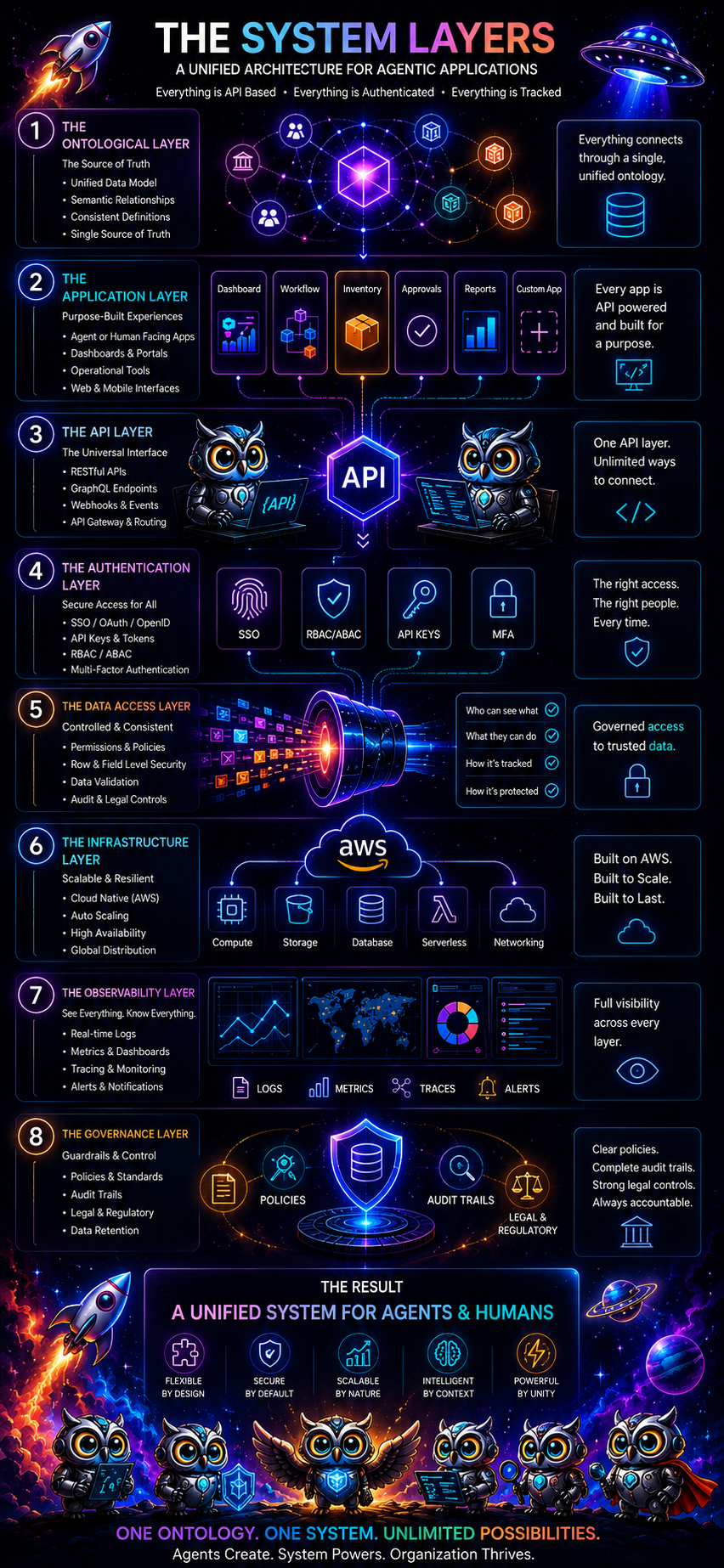
A cleaner reconstruction of the architecture: access and identity feed a cloud services layer, the core data platform stores entities and relationships, the ontology maps meaning across realities, and dynamic interfaces render the work.
Employees, managers, customers, vendors, admins
Web, mobile, embedded portals, assistants
Cognito, SSO, MFA, roles, permissions
CRM, ERP, HRIS, vendors, files, APIs
Services, workflows, model calls, search, file storage, and event movement.
GraphQL, REST, service boundaries
Step functions, events, orchestration
Models, agents, RAG, summarization
Hybrid text, vector, and graph search
Documents, backups, notifications
Canonical entities, weighted relationships, metadata, permissions, audit, files, roles, and history.
Operational objects, relationships, metadata, permissions, and history
Local realities mapped into shared organizational meaning
Dynamic interfaces generated around role, task, context, and confidence
A system that respects multiple realities without giving up shared truth
The relational substrate remains legible: tables, keys, files, roles, and permissions.
Articles, policies, vendors, products, assets, tickets, cases, documents, customers, employees, orders, locations, and workflows become operational objects.
A relationship table can carry source entity, target entity, relationship type, confidence, weight, creator, and timestamp.
Tags, categories, custom attributes, lifecycle state, source system, roles, memberships, row-level security, and object permissions shape what can be seen.
Change logs, version history, access logs, lineage, event history, and compliance logs help the system explain changes over time.
The ontology layer then decides how different teams can interpret that substrate without erasing their local context.