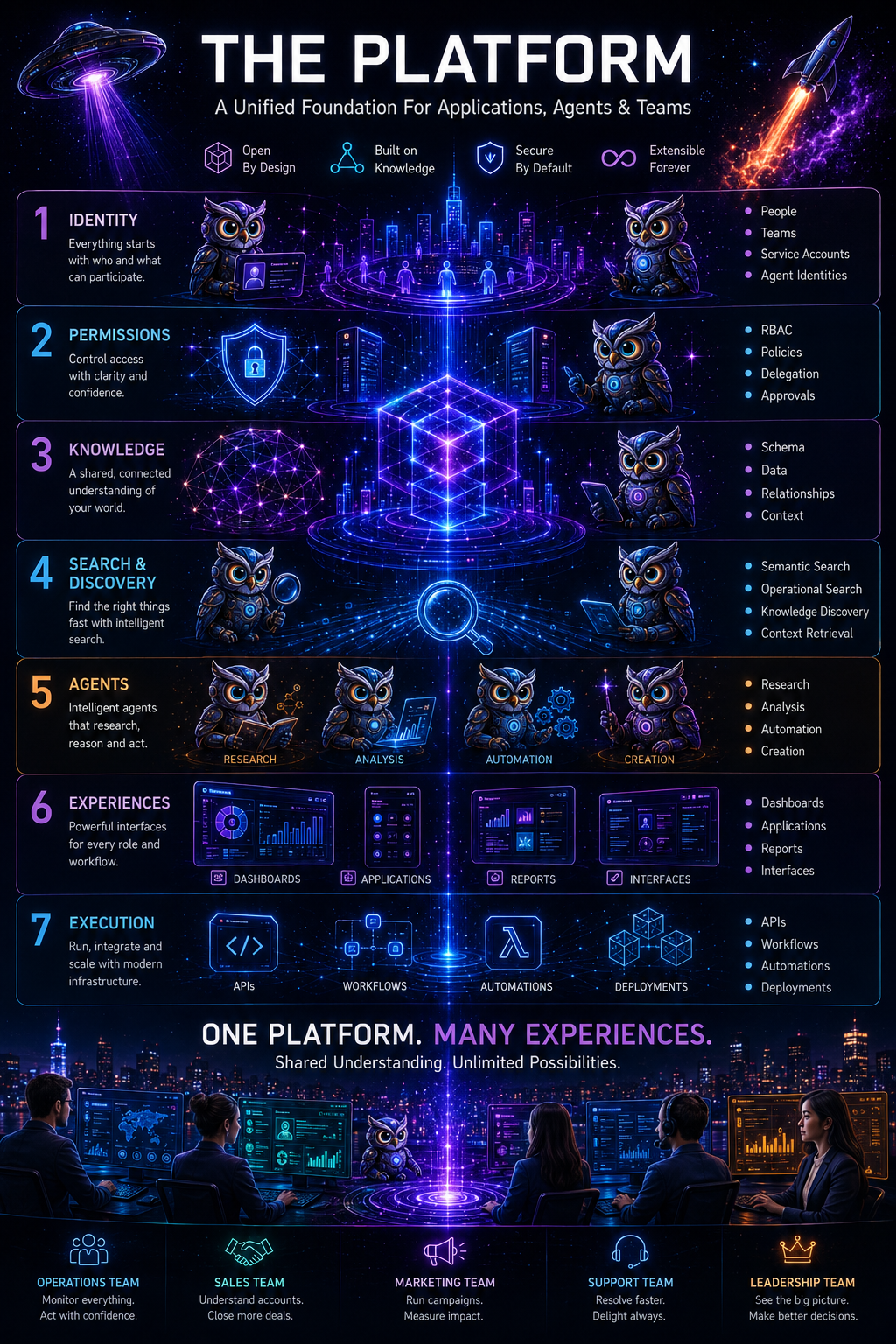
The proposal does not require a magical new cloud. It starts with access layers, identity, operational sources, APIs, storage, events, search, and AI services that already exist, then composes them around operational meaning.
The access layer should support web apps, mobile apps, embedded portals, and assistant surfaces without making any one interface the center of the system.
Identity and security need to be native to the architecture because semantic access is only useful when it respects roles, permissions, sessions, and compliance boundaries.
External operational systems remain sources of truth, but their records become more useful when mapped into relationships and context.
Cloud approach
The cloud layer coordinates APIs, services, workflows, search, AI calls, file storage, and event movement. It is the connective layer, not the meaning layer.
API gateway and service layerWorkflow orchestrationSearch and discovery servicesAI and intelligence layer
Access layer
Users should not be forced into one interface. The same operational ontology can surface through web apps, mobile apps, embedded portals, and assistants.
Web applicationsMobile surfacesEmbedded portalsAssistant and search interfaces
Identity and security
Cognito, SSO, MFA, roles, attributes, permissions, and session policy become part of how meaning is safely exposed.
SSO and OIDCRole and attribute controlsSession managementObject-level visibility
Operational sources
CRM, ERP, HRIS, vendor tools, files, databases, and other systems feed the platform through connectors, APIs, webhooks, and ETL paths.
CRM and customer recordsERP and order dataHRIS and people dataVendor and document systems
The platform is the assembly layer.
The deeper value comes from what the cloud layer enables: a core system that can hold operational objects, relationships, permissions, and history.